Safety comes first. To the tower, doing the right things can be the difference between a great tow and disaster. This article gives tips to improve tower safety and is worth a look..


From the State Compensation Insurance Fund of California Website

Tow Truck Operations

Tow truck operators transport cars and trucks that are damaged, non-operational, or parked illegally, aid motorists, and keep streets and highways clear. Traffic never stops, so tow truck operators are called out at all times of day, year-round. The job involves personal safety, driving, heavy equipment, and traffic safety, so operators should learn safety basics for tow truck operations.

Mind your personal safety; ensure that someone is tracking or has a record of your planned route. Don’t enter a situation that looks or feels dangerous; be calm and diplomatic when dealing with customers. When exiting your truck, be aware of the traffic around you; look and think before you make a move. To avoid a fall, use the steps and handles getting in and out of the truck; never jump in or out of the cab or bed.

Maintain your fitness for the job which may require stretching, bending, lifting, and climbing. Use good body mechanics and lifting techniques to avoid back injuries. Don’t strain, twist, or over-reach, and avoid extreme or awkward positions as much as possible.

Drive defensively and stay alert. Avoid alcohol, drugs, and medications that cause drowsiness. Follow safe hours of service guidelines. Wear your seatbelt. Obey speed limits and road regulations. Don’t multi-task; keep your eyes and mind on the road. When towing, use your lights or a light bar to signal your intentions and show the rig length.

Know your equipment rating and capacity; overloading may cause an accident. Be aware of your truck height for maneuvering under overpasses and bridges. Inspect the truck before each use. Check the utility body and mounts and fix broken bolts, cracked welds, or stress fractures. Inspect the chains and hooks on the rig; make sure the security pins are not bent or falling out and the chain has no bent, stretched, or hammered links.

Inspect the winch and cable often, keep it clean and lubricated; repair or replace if necessary. Use hooks and clamps rated at the same capacity as the wire. Maintain 3 to 5 wraps on the winch drum and rewind it periodically to lay the cable flat and even. Watch the lines so that they don’t get tangled; placing continued pressure can shear the cable and send it flying at high speed.

When hooking up a towed vehicle, block and chock the wheels before disengaging the driveshaft or the brakes. Try not to work under a lifted truck; if you must do so, block and chock the wheels, front and back. Use lockout/tagout procedures on the wheel lift, boom and winches while working under a truck or between the truck and towed vehicle. If you have a remote to the lift, boom or winch, do not leave it in your pocket or on the ground where it could be accidentally activated; lockout and secure the remote inside your truck until you are ready to use it.

When working in the tow-away zone, stay in the safety zone.

tow safety, towsafe, towpart, towing, winch, winch cable, snatch block, hook


Recovery Straps - Proper Usage


How recovery straps work and how to use them properly
By Robert B. of Gator4x4 Club

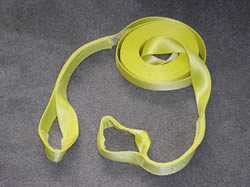
The right recovery straps and how to use them can make the difference if you can pull your vehicle out safely or if you have to wait on a tow truck. A high quality strap without hooks attached to it is the strap you want to use for getting a vehicle unstuck.he above is called a "tow" strap. The main reason not to use this for recovery is simple. If the recovery strap or your recovery hardware breaks, it's not safe to have a metal hook flying off at speeds in excess of 100 mph.Many people have been killed and seriously injured by using these straps incorrectly. These straps will not stretch because they are made for towing, not recovery.
Let me first clarify what we are talking about.How a Recovery Strap Works

The strap works like this. Say for example you are pulling out your friend, so you attach your recovery strap to the back of your vehicle and then to the front of his. As you drive away from him the recovery strap stretches just like a rubber band. The strap wants to go back to its normal size, so it has no other choice than to transfer the energy to the stuck vehicle, pulling it out.

Recovery straps are flat with sewn loops and no hooks. They are nylon, not polypropylene or Dacron or chain. Because the straps are made of Nylon, they stretch. They are safer than chains, easier to use, and not nearly as heavy.

Specifications
I've seen recovery straps come in lengths of 20 to 40 feet and widths from 2 to 6 inches. A general rule of thumb, each inch of width will allow you to pull out about 10,000 lbs. So if I have a 3 inch wide strap, it would be rated to tug up to 30,000 lbs. Many will then ask, why not go all the way up to a 6" wide recovery strap? The problem is that the strap becomes less elastic the wider it gets, which means it will not work properly. Typically a 2" or 3" wide recovery strap will suit all of your needs.

Tips for Recovery Strap Use

* Before ever using the strap, make sure it is in good condition ( no cuts, frays, or broken stitching.)

* Make sure the hardware being used is free of defects and rust. This includes your tow hooks or front hitch and the hardware on the other vehicle. If possible, the recovering vehicle should place the recovery strap to its rear end, which would be the safest place if the strap happens to break.

* You may be able to wrap the strap around a hitch, but I would not put it IN the hitch. I have seen a few people who have bent the pin, which then had to be cut out. Getting a tow hook or D-Ring adaptor to go into the hitch is a better idea. Here is an example of a D-Ring adaptor and how a recovery strap should be hooked up to one:


* Some older cars actually have tow hooks, but if not you must use your own judgment. Never attach a recovery strap to a vehicles bumpers, axles, suspension, steering rods, or a trailer hitch ball. The attach points must be to a secure place on the vehicles frame. Do not place the recovery strap on another vehicle in a way that it may be cut.

* Never, ever, attach a recovery strap to another vehicle with a knot. You should pass one end of the strap through the loop at the other end of the strap to secure it on.

* Incase the strap may break, lay a tarp or some jackets on top of the recovery strap. When the strap breaks (lets hope for the best, but prepare for the worst), the jackets or tarp will slow the recovery strap down before it hits someone.

* To help protect the strap from tears, make sure all logs and large rocks are removed from the recovery path. Everyone should stand clear of the recovery strap when it is in use.

* When pulling the vehicle out, drive very slowly. Sudden tugs may lead to damage to either of the vehicles or the strap.

* Once the vehicle is safely removed, inspect your recovery strap and hardware and hit the road!
In addition to these recommendations, read the instructions your recovery strap comes with. To protect your strap, store it out of sunlight and away from heat and keep it clean. Dirt, mud and debris embedded in a tow strap actually damages the fibers over time and can decrease its strength. After a muddy day of wheeling and recovery, always clean your straps by hosing them off and spray horizontally across the strap as not to push the debris into the strap fibers. Happy Recovering! recovery strap, recovery straps, towing straps, straps, tow parts, towing parts,recovery strap, recovery straps, towing straps, straps, tow parts, towing parts,

----------------------------------


No one knows towing like a towman


Sometimes the best way to learn about towing, towing techniques, towing parts, towmen, wreckers and rollbacks is to hear it from the person doing it. Here is an interesting question and answer session link pulled from Bill's towing

Bills Towing and Recovery Website
http://www.billstowing.net/towingfaq.htm

towing, towing techniques, towing parts, towmen, wreckers and rollbacks

Cinco DeMayo Aftermath?

Cinco De Mayo: Party & Parking Tickets At Hacienda

One Way Road!

From Wreckmaster


I’d like to share a true story with you. I was flying home from a class I presented in Casper Wyoming back in April 2004. It was a big jet, 747 maybe. Anyway, I sat at the window in a row of three seats. Next to me sat a woman and a man who I assumed was her husband. I was reading an article in an industry publication and she asked me what I did for a living. I responded “I Train Towing and Recovery Operators” without missing a beat she then said “They Are All a Bunch of Crooks” and at first I was stunned by her comment, but after processing what she had said for a moment I responded with my own question. “Why Would You Say That”? She then proceeded to tell me about the time her car was towed from alleged illegally parked position by police order and she was in her opinion charged an exorbitant fee and treated poorly by the people at the towing business.

DOES THIS SOUND FAMILIAR??

The Towing & Recovery Industry has long suffered the patronizing stigma as being of unsavory characters. While there are certainly unscrupulous individuals who are attracted to our industry like every other, the majority are individuals who are productive members of society. Men and women of integrity, who are family oriented, charitable, and involved in their communities, churches, schools, fire departments and so on. So why does the patronizing stigma still haunt us? Let’s face it we make our livelihood from the misfortunes of others. The people we encounter are not typically having a good day. They are not happy people! And all too often they vent their frustration on the very people who are there to help. “The Tow Operator or Tow Company”

We are in the business of delivering a service. We strive for excellence in the services we deliver. While we will never reach perfection I think we can all agree we could be a little more perfect in the excellence of the service delivery process. While a tow business may be very successful they may also be lacking in service excellence. Success doesn’t lead to excellence but excellence will lead to success! That is a one-way road.
  1. Education and training are the seeds of excellence. Knowledge instills confidence, enthusiasm, and ambition to be the very best we can be. A working knowledge of the equipment, casualty, logistics, and legalities will gain the customers trust. And lets not kid ourselves trust is paramount in our industry.
  2. Attitude is an important ingredient to excellence as well. Making sure we are mentally equipped to calm and help make customers feel at ease with their situation. Avoid negative comments, misunderstood industry terminologies and jargon, stay focused, and remain calm at all times.
  3. Appearance is often underrated in our industry. A well groomed individual who is dressed in attire befitting their roll will instill confidence and a feeling of safety and security within the customer. The workstation should also be neat and clean in appearance and organized where everything is accessible and familiar.
These 3 elements are critical to the Excellence of Service that will lead down the one-way road of success!

Cya in the Ditch!

David Bouvia
Lead Instructor
WreckMaster Inc.

Tips for Towing Disabled Vehicles

Tips for Towing Disabled Vehicles
Sophisticated new vehicles require great care and different types of towing techniques.

By Ann Job of MSN Autos

Click to enlarge picture

Always make certain that the tow truck driver knows the proper way to tow your vehicle.

On occasion, our car, van, truck or sport-utility vehicle can break down and need to be towed.

Decades ago, it wasn't uncommon to see a friend, family member, neighbor or Good Samaritan towing the stranded vehicle home for a needy driver.

It's rare to see this today—for good reason.

Towing practices, like today's vehicles, are more sophisticated than they were years ago— so sophisticated, in fact, that there are more rules and "don'ts" than ever before.

Even AAA, the largest member-supported roadside assistance service in the United States, offers a towing manual for tow truck operators that has "more than 350 pages of details involving every make and model," said Larry Keller, editor at AAA of Michigan.

As each year progresses, AAA sends out further towing news via service bulletins, Keller said.

So, no, towing isn't a simple procedure where someone throws a rope or chain around a car's front bumper and "tows" the vehicle home.

In fact, if there's one key thing to remember about towing, it is that you should always follow the owner's manual and make sure your tow truck operator does, too. If he refuses to do so, find another tow truck.

Otherwise, you can face the risk of damage to your vehicle.

Safety Considerations
These days, there is much more emphasis on safety in towing, with the realization that there's a potential for injury or even death during towing maneuvers.

For example, in the early 1980s, a Good Samaritan driver was killed in the Upper Peninsula of Michigan when he attempted to tow another driver out of a snow bank.

The man died when the chain he had attached to the other vehicle broke and the loose end flew into the back window of his truck cab, striking him in the head.

There are other towing dangers, too.

Do-it-yourself towed vehicles don't have lights and flashers that tow-truck drivers use to alert other drivers that they're approaching a disabled car. So other drivers can come up quickly at the back of these vehicles-in-tow and rear-end them, since they typically aren't keeping up with traffic.

Chris Matthews, an Automotive Service Excellence-approved technician and coordinator of the AAA-approved auto repair program, pointed out that brakes on a DIY-towed vehicle typically are crippled as well because with the vehicle's engine not on, there's no vacuum boost to help the brakes work normally.

Thus, if the vehicle that's pulling a disabled car stops suddenly, it's likely the towed vehicle won't be able to stop in time to avoid rear-ending the tow vehicle.

Steering can be another problem, with so many of today's vehicles featuring power-assist steering systems, not to mention steering wheel locks. Note that when the engine is not operating, there is no power assist, so attempting to steer a towed vehicle requires substantial extra effort.

Avoiding Mechanical Damage
Vehicle owners also should want to make sure their vehicles aren't damaged during towing.

Each owner's manual provides specific instructions and warnings for each vehicle and should be strictly followed.

Subaru spokesman Rob Moran, for example, notes that the owner's manuals for all new Subaru Forester, Legacy and Impreza models—basically every Subaru with standard all-wheel drive—tell drivers that all four wheels need to be off the ground when a Subaru is towed. This is also known as flat-bedding.

Otherwise, "you could get damage to the transmission or differential," he said.

Matthews explained because all four wheels get power and are therefore "tied together," there's really no way to put any of the wheels to the ground and not have the transmission or transaxle "burn up."

The reason? Simply, as any of the drive wheels moves while the vehicle is improperly towed, mechanicals in the transmission and sometimes in the differential move, too. Since the engine isn't operating, there are no fluids flowing to keep the parts lubricated.

The Cadillac Escalade with all-wheel drive has caused special problems in towing, Matthews said.

The Escalade AWD can't be pulled behind a tow truck, but must be flat-bedded for the same reasons described for Subaru vehicles.

Since an Escalade AWD weighs more than 5,500 pounds, a medium-duty flat-bed truck is required, and "they're hard to come by as a lot of [roadside service companies] may not have them," Matthews explained.

Cadillac engineers are working on a solution, he added.

Front- and Rear-Wheel-Drive Vehicles
Lubrication is an issue in rear- and front-drive vehicles, too, and draws attention to the need for tow-truck operators to be skilled in different towing procedures.

For example, the Mazda RX-8 is a rear-wheel-drive car and "should have its rear wheels off the ground" if it's being towed, according to the owner's manual.

By keeping the rear wheels, which are the wheels that receive power via the transmission and driveshaft, immobile and off the ground, there's no moving of the linked parts and thus, no lubrication issues.

In contrast, a front-wheel-drive car is generally OK to tow with its front wheels off the ground for the same reason, Matthews said.

In this case, the front wheels are the drive wheels connected to driveshaft and transmission and so need to be kept immobile during towing.

Beyond the driveline issues, owners of vehicles with lowered chassis and sport-body appearance kits should be sure tow truck operators take extra care to ensure the spoiler, lower body kit pieces and/or undercarriage aren't damaged as a vehicle is raised and lowered onto a truck.

Other Towing Insights
You might wonder, then, just how RV owners manage to flat tow vehicles behind their large mobile homes.

Actually, I've long wondered why I see so many Saturns towed behind big RVs.

Sue Holmgren, Saturn spokeswoman, had the answer. In fact, she said lots of RVers know that Saturns are easy to flat tow, and typically don't require major modifications, such as a lubrication pump or driveline disconnection, before towing.

Specifically, all Saturn S-Series and L-Series cars, even with automatic transmissions, and all Ions and VUEs with manual transmissions can be flat towed. Owners must follow instructions in their manuals. But RVers take note: L- and S-Series Saturns are no longer in production.

Automatics tend to be more problematic. Holmgren noted the S- and L-Series Saturns have automatics with bearings, which require less lubrication than do automatics on some other cars that have bushings or thrust washers.

In addition, "the input shaft into the torque converter needs to be able to rotate freely," which is what these Saturns have, she said.

Generally, a vehicle can be flat towed as long as the transmission internals are not turning. Thus, an SUV trailing behind a big RV most likely has had its driveshaft disconnected from the transmission.

Bottom line: It is critically important that vehicles be towed according to the owner's manual instructions.

Ann Job is a freelance automotive writer.